Most patients visit their dentist more frequently than any other doctor. Because of this, dentists play a particularly important role in the early detection of internal diseases, as existing systemic
$395.00 ex GST
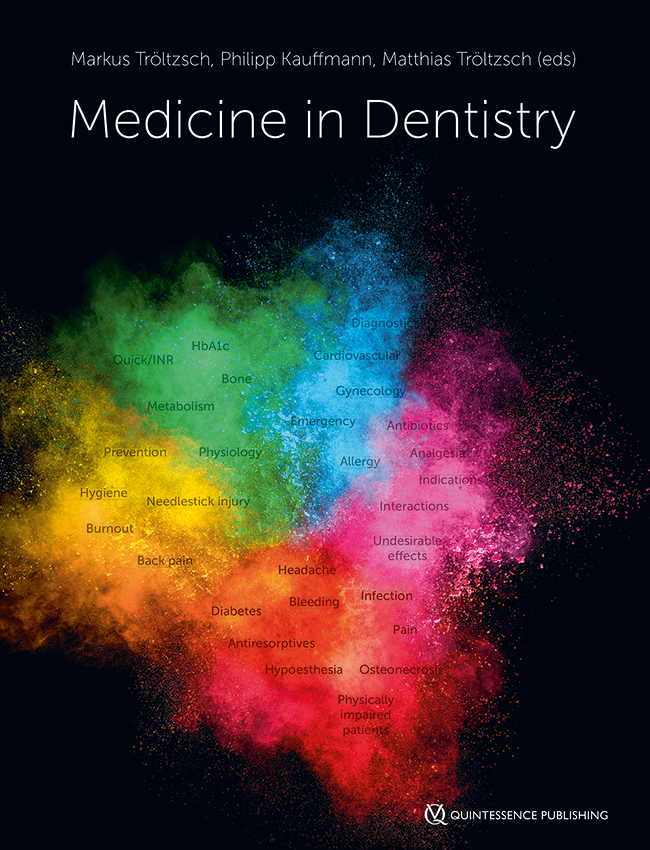
Most patients visit their dentist more frequently than any other doctor. Because of this, dentists play a particularly important role in the early detection of internal diseases, as existing systemic diseases have an influence on dental treatment. The much-discussed effect of an aging society — with its accompanying multimorbidity and multimedication — reinforces this fact considerably and highlights the relevance of medical knowledge in everyday dental practice.This book, curated by three editors with dual qualifications in dentistry and medicine, provides the knowledge required for everyday practice and supports the planning of dental treatments in light of various medical challenges. Symptoms occurring during treatment are discussed, and procedures are presented in a problem- and action-oriented manner. Each article in the book can be read individually as a stand-alone topic of interest or in conjunction with the others as part of the global picture. With a concluding chapter on keeping the dental team healthy, the book ensures confidence in everyday dental practice.Contents1. Basics
Anatomical basics
Bone and skeletal system: Anatomy, histology, physiology, and pathophysiology
Pain and wound healing
Laboratory examination: Which values are important for the dentist?
2. Pharmacology
Basics of pharmacology
Antibiotic therapy in dental practice
Analgesic therapy in dental practice
Recommendations for the target-oriented and reasonable use of pharmaceuticals in the dental office
Drugs relevant to dentistry and their interaction with frequently prescribed drugs
Medication-associated osteonecrosis of the jaw
The Role of new antiresorptives, neoangiogenesis inhibitors, and immunomodulators in the development of osteonecrosis of the jaw
Coagulation and anticoagulants
Cause and therapy of hemorrhage
Management of the anticoagulated patient during dentoalveolar surgery
The Immunocompromised patient in the dental practice
3. Common medical conditions relevant in dentistry
The medical importance of dentistry
Medical diagnostics in dental practice
Coronary heart disease
Cerebrovascular events—Epidemiology, symptoms, etiology, diagnosis, prognosis, and prophylaxis
Venous thrombosis
Endocarditis
Diabetes mellitus and dentistry
Dental treatment of patients with chronic renal insufficiency
Metabolic bone diseases and osteoporosis
Lung infection: Basic pulmonary physiology and pathophysiology and the diagnosis and therapy of pneumonia
Chronic obstructive pulmonary disease (COPD)
Asthma management
The pregnant patient
Sinusitis: Clinical presentation, diagnosis, and therapy
Inflammatory diseases of the ear
Salivary gland diseases
Colorectal and bronchial cancer
Breast cancer (Mammary Carcinoma)
Neoplasms of the blood
Prostate cancer—The most common malignant neoplasm in men
Allergic reactions and their significance in dental practice
Headache in dental practice: An introduction
Headache and facial pain
Emergency medical care in the dental practice
Sedation and anesthesia
Managing multimorbid patients in the dental practice
Dementia: Epidemiology, manifestations, diagnosis, therapy, and prognosis
Multiple sclerosis: A chronic degenerative disease of the central nervous system
Parkinson disease
Sleep-related breathing disorders and dentistry: Where is the connection?
Standardized examination and special diagnostic procedures in oral medicine
Oral cancer
Odontogenic infections Part 1: Pathology
Odontogenic infections Part 2: Diagnostics and therapy
Odontogenic infections Part 3: Complications and differential diagnoses
Imagined ugliness: Body dysmorphic disorder
Basics of traumatology, fracture healing, and principles of osteosynthesis
4. Medical knowledge for the dental team
Prevention and early detection of malignant diseases
Hygiene in practice and surgery
The needlestick injury in practice: An almost everyday problem
Dentistry and ophthalmology
“There is a cost to caring:” Prevention of burnout for the practice team
Burnout in dentists: A literature review
The back: Classic problem area for the dentist
Dupuytren disease—When the fingers no longer cooperate
Disease transmission and risk of infection in dental practice using SARS-CoV-2 (COVID-19) as a particular example
5. AppendixWith contributions from:Thiha Aung • Tomas Aydin • Anna Greta Barbe • Deike Böning • Florian Böhrnsen • Irene Bopp-Kistler • Michael M. Bornstein • Phillipp Brockmeyer • Robert Cordesmeyer • Sonja Henny Maria Derman • Michael Ehrenfeld • Michael Eichhorn • Günther Eisele • Ruben Evertz • Nicolas Feltgen • Dietrich Friesen • Charly Gaul • Sophia Goldschmidt • Rudolf Gruber • Ursula Hanf • Karin Hohloch • Friedrich Ihler • Hans-Peter Jöhren • Katharina Kauffmann • Philipp Kauffmann • Jan Alexander Klenke • Ines Kollei • Stefanie Kriegelstein • Rainer Laskawi • Nils Lohse • Alexandra Martin • Karl Meßlinger • Norman Moser • Luise Mortag • Sebastian Müller • Michael Johannes Noack • Sven Otto • Christoph Pache • Christoph Pautke • Florian Andreas Probst • David Raschke • Anna Rau • Christian Rau • Christoff Reichelt • Oliver Ristow • Claudio Rostetter • Sebastian G. Russo • Sinan Sag • Petra Maria Santander Martínez • Jan Samuel Schenkel • Sven Schippling • Andreas Schwarzkopf • Daniel Stein • Valérie G. A. Suter • Markus Tröltzsch • Matthias Tröltzsch • Patricia Tröltzsch • Frank Unglaub • Radovan Vasko • Stephan von Haehling • Carolin Isabell Wissel • Heinrich Worth